


The year 2026 has officially arrived, and the conversation around quantum computing has shifted from “if” to “how.” For years, we treated quantum computers like science fiction—mystical machines locked in sub-zero laboratories that might one day change the world. Today, that day is here. We are no longer just theorizing about qubits and entanglement; we are seeing industries from logistics to medicine utilize quantum-classical hybrid systems to solve problems that were previously impossible for even the fastest supercomputers.
As these machines become more integrated into our digital infrastructure, the demand for “quantum literacy” has skyrocketed. Professionals and researchers are scrambling to understand how to code for these systems. If you find yourself overwhelmed by the technical shift, seeking expert assignment help from established platforms like myassignmenthelp can provide the necessary clarity to master these complex physics and computing concepts. Understanding the transition from the NISQ (Noisy Intermediate-Scale Quantum) era to fault-tolerant computing is now a requirement for anyone entering the tech workforce in 2026.
The Shift from Lab to Life: Why 2026 is Different
In the early 2020s, quantum computers were plagued by “noise”—errors that occurred because qubits are incredibly sensitive to their environment. However, 2026 marks a turning point with the implementation of advanced error correction protocols. Tech giants and startups alike have reached milestones where quantum processors can now maintain “coherence” long enough to perform meaningful work.
We are currently in a hybrid era. This means companies aren’t replacing their standard computers with quantum ones. Instead, they are using “Quantum Cloud Services.” Think of it like a specialized power tool: you don’t use a jackhammer to hang a picture frame, and you don’t use a quantum computer to check your email. You use it when you have a massive, multidimensional math problem that would take a normal computer ten thousand years to finish.
1. Quantum-Safe Encryption: Protecting Your Digital Identity
Perhaps the most “real-world” application we are dealing with today is the overhaul of our cybersecurity. For decades, our bank accounts and private messages have been protected by RSA encryption—a system based on the fact that normal computers are very bad at finding the prime factors of giant numbers. Quantum computers, however, are very good at it.
In 2026, we are seeing the mass adoption of Post-Quantum Cryptography (PQC). Financial institutions and government agencies have spent the last two years migrating to quantum-resistant algorithms. This isn’t just for experts; even the software on your smartphone likely received an update recently to ensure your data stays safe in a world where “Shor’s Algorithm” (a quantum formula that can break codes) is a reality.
2. Molecular Simulation: Designing Better Medicine
Before 2026, creating a new drug was a lot of guesswork. Scientists had to test chemicals in a lab because classical computers couldn’t accurately simulate how a new molecule would behave in the human body. Molecules are quantum objects, so it makes sense that you need a quantum computer to simulate them.
Today, pharmaceutical companies are using quantum molecular simulation to discover new treatments for Alzheimer’s and more efficient ways to capture carbon from the atmosphere. By simulating the “folding” of proteins at a subatomic level, researchers are cutting the time it takes to develop life-saving medicine from ten years down to two.
3. Understanding the Hardware: The Quantum Stack
To understand how these applications work, we have to look at the hardware. In 2026, we have moved beyond just superconducting loops. We now use trapped ions, photonic chips, and neutral atoms to process information. Each method has its pros and cons, but they all share the same goal: maintaining a stable quantum state.
| Feature | Classical Computing | Quantum Computing (2026) |
| Data Unit | Bits (0 or 1) | Qubits (Superposition of 0 and 1) |
| Processing | Sequential/Linear | Parallel (Exploring all paths at once) |
| Best Use Case | Spreadsheets, Web Browsing, Video | Optimization, Chemistry, Cryptography |
| Error Rate | Almost Zero | Decreasing (due to Error Correction) |
| Temperature | Room Temperature | Often requires Absolute Zero (-273°C) |
4. Logistics and the “Traveling Salesman” Problem
Every day, millions of delivery trucks, ships, and planes move around the globe. Finding the most efficient route for all of them at once is a mathematical nightmare known as an optimization problem. Classical computers get bogged down when you add too many variables, like weather, traffic, and fuel costs.
Quantum logistics optimization is now a standard tool for global shipping firms. By using quantum annealing—a specific type of quantum computing—companies can calculate the perfect route for an entire fleet in seconds. This doesn’t just save money; it significantly reduces the carbon footprint of global trade by cutting down on unnecessary travel time and fuel consumption.
Learning the logic behind these algorithms is a hurdle for many computer science students. If you’re struggling with the code behind these optimization models, getting specialized Programming Assignment Help can be a game-changer for your grades and your understanding. This kind of professional support, found on sites like myassignmenthelp, ensures you can bridge the gap between theoretical math and actual Python or Q# programming.
5. Financial Modeling: Beating the Volatility
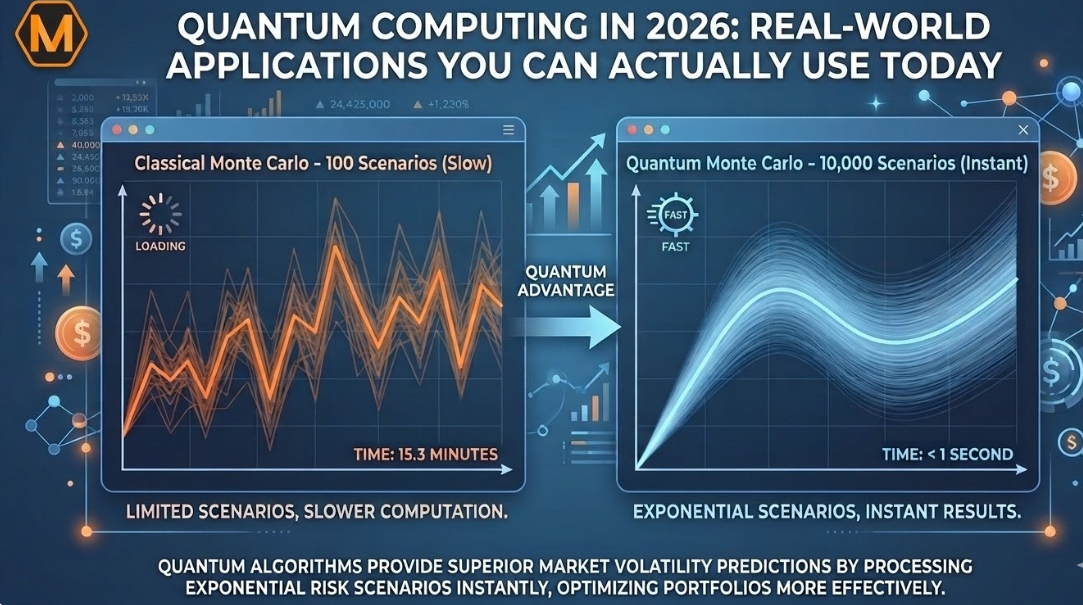
The stock market is essentially a giant collection of unpredictable human behavior and global events. In 2026, “Quantum Finance” has moved from a niche research topic to a core part of Wall Street. Investment firms use quantum algorithms to perform “Monte Carlo simulations” at lightning speed.
These simulations help predict market crashes and optimize investment portfolios to minimize risk. By analyzing thousands of different “what-if” scenarios simultaneously, quantum systems provide a level of financial foresight that was simply unavailable five years ago. This helps stabilize the economy by allowing banks to better prepare for sudden market shifts.
6. Developing New Materials: The Super-Battery Era
We all want phones that last a week on a single charge and electric cars that can travel 1,000 miles. The bottleneck has always been battery chemistry. Much like drug discovery, designing a better battery requires understanding the quantum interactions inside a chemical cell.
In 2026, quantum computing is being used to discover new materials for solid-state batteries. These materials are safer, hold more energy, and charge faster than the lithium-ion batteries we’ve used for decades. This application is a massive win for the environment, as it accelerates our move away from fossil fuels and toward a fully electric future.
7. AI and Quantum Machine Learning (QML)
Artificial Intelligence has been the biggest story of the decade, but in 2026, it is getting a “quantum boost.” Standard AI requires massive amounts of data and energy. Quantum Machine Learning allows models to learn from smaller datasets and find patterns that classical neural networks would miss.
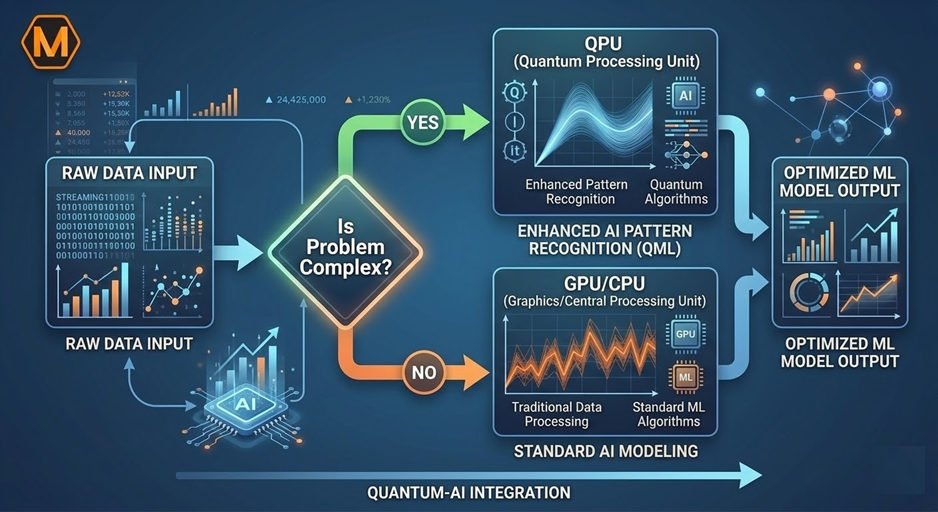
QML is currently being used to improve weather forecasting and natural disaster prediction. By processing the chaotic data of the atmosphere using quantum probability, we can now predict hurricanes and heatwaves with 95% accuracy up to two weeks in advance. This saves lives and helps cities prepare for the effects of climate change.
8. The Impact on High-Performance Computing (HPC)
The integration of quantum units (QPUs) into traditional data centers has created a new class of “Super-HPCs.” These centers act as the brain of the modern world. In 2026, researchers can log into a cloud dashboard, write a piece of code in a language like Qiskit, and have it run on a quantum processor located halfway across the world.
This accessibility has democratized science. Small universities and independent researchers now have the same “computing power” as billion-dollar corporations. It has led to a surge in grassroots innovation, particularly in renewable energy and sustainable agriculture.
9. Ethical Considerations and the “Quantum Divide”
As with any powerful technology, we must address the ethics. There is a growing concern about the “Quantum Divide”—the gap between countries that have quantum capabilities and those that do not. If one nation can break all existing encryption while others cannot, it creates a massive power imbalance.
International bodies are currently working on treaties to ensure that quantum technology is used for the “global good.” This includes open-sourcing certain quantum algorithms and ensuring that life-saving drug discoveries are shared across borders. The goal is to make 2026 the year of inclusive innovation, not just exclusive power.
10. How to Get Started in the Quantum Era
You might be thinking, “I’m not a scientist, why does this matter to me?” The reality is that quantum computing is the “new internet.” Just as people in the 1990s had to learn how to use a web browser, people in the mid-2020s need to understand the basics of quantum logic.
Education systems are pivoting. High schools and universities are now introducing “Quantum Logic 101.” The goal isn’t to make everyone a physicist, but to make sure everyone understands how data is processed in this new era. It’s about being prepared for a job market where “quantum-ready” is a common requirement on LinkedIn.
Conclusion: The Future is Already Here
Quantum computing in 2026 isn’t just about big machines in cold rooms. It’s about the medicine you take, the way your packages are delivered, the security of your bank account, and the battery in your car. We have moved past the hype and into the era of utility.
The transition is fast, and it can be intimidating. Whether you are a student trying to keep up with your coursework or a professional looking to pivot your career, the resources are out there. Don’t be afraid to use expert tools and educational support to stay ahead of the curve. The quantum revolution isn’t coming; it’s already happening.
Frequently Asked Questions
What exactly is a “hybrid” computing model?
In 2026, most businesses do not use quantum computers for every task. Instead, they use a hybrid approach where classical computers handle standard data processing and only send specific, complex mathematical problems to a quantum processor via the cloud.
Do I need a physics degree to work with quantum technology?
Not necessarily. While the underlying mechanics are complex, the development of user-friendly programming languages and cloud-based platforms allows software developers to utilize quantum power without needing an advanced degree in subatomic physics.
Is my current online banking data at risk?
While quantum systems can theoretically break traditional encryption, most financial institutions have already migrated to quantum-resistant security protocols. As long as you keep your software updated, your digital identity remains secure.
Why are quantum computers kept in extremely cold environments?
Qubits are incredibly sensitive to heat and electromagnetic interference, which can cause them to lose their “quantum state” and create errors. Super-cooling them to near absolute zero ensures they remain stable enough to perform accurate calculations.
About The Author
Ella Thompson is a dedicated education consultant and researcher with a focus on how emerging technologies influence modern learning. By collaborating with platforms like MyAssignmentHelp, Ella provides students and professionals with the insights needed to navigate the complexities of today’s digital and academic landscape.
